Author Archive
Doornbos Fastest in Rookie Practice at Indy
Posted by: | CommentsIt's May and that means the gates at Indianapolis are open for business.
Rookie Orientation commenced on Tuesday and four drivers passed their tests: Mike Conway, Robert Doornbos, Raphael Matos, and Alex Tagliani. Of the four, Doornbos turned the fastest lap at 221.735 mph. Rookies Stanton Barrett and Nelson Philippe will complete their programs on Thursday. Wednesday activities were washed out only 50 minutes after the track went green.
Also on Tuesday was the Veteran Refresher program for drivers returning to Indy after an extended layoff. Of the drivers participating -- Alex Lloyd, Scott Sharp and Paul Tracy -- Tracy posted the fastest lap at 223.069 mph.
Tracy has not participated in the Indy 500 since a controversial finish in 2002. In that race, Tracy was executing a pass on leader Helio Castroneves entering turn three when the caution flag was displayed for a crash in turn two. The race ended under caution. Officials declared that Tracy had not completed the pass before race control had called for the yellow flag, giving Castroneves the win. Tracy's team later appealed the decision and lost, and Tracy decided not to return to Indianapolis.
Prior to 2002, he had four Indy 500 starts -- 1992 through 1995 -- failing to finish in each of them.
The Speedway officially opens practice to all drivers and cars on Thursday in preparation for the Memorial Day weekend race. The 2009 race is the 93rd running of the Indianapolis 500, the 14th under Indy Racing League sanction and the Speedway itself is celebrating its 100th Anniversary.
Pole Day qualifying is set for this Saturday, May 9. Based on Tuesday's times I suspect the pole will be somewhere in the upper 220s.
Martin to Run Full Schedule in 2010
Posted by: | CommentsIt looks like Mark Martin will be making another run for the NASCAR Sprint Cup Championship in 2010. NASCAR.com is reporting that his contract with Hendrick Motorsports has been adjusted to run all 36 races in 2010. Martin, running full time this year, originally agreed to run just 26 races next season.
"It means a lot to drive the No. 5 Chevy for Rick [Hendrick] and for Hendrick Motorsports," said Martin, 50, of Batesville, Ark. "I'm in the best condition of my life, I'm recharged, and I'm motivated. Going to the race track every weekend is still really fun, and that's the key. There's more gas in my tank."
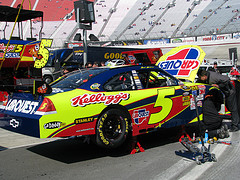
Mark Martin will run a full Cup schedule with Hendrick Motorsports in 2010.
(Photo by cbgb_chopper on flickr.com, CC 2.0.)
After 10 races in 2009, Martin has a win (at Phoenix) and three poles, but three finishes of 40th or worse have relegated him to 15th in the point standings.
The 2009 season started off well for Martin and the #5 team, starting the Daytona 500 from the outside pole. But then the team suffered engine failures in the next two races at California and Las Vegas. The team quickly bounced back with consecutive poles at Atlanta and Bristol, and then four consecutive top-tens, including the win two weeks ago at Phoenix. Martin got caught up in the first big crash at Talladega and finished last, but rebounded to a fifth place finish at last week's Crown Royal 400 at Richmond.
Smith: NASCAR Should Mandate Fence Standards
Posted by: | CommentsHere's an interesting article from ESPN.com:
CONCORD, N.C. -- The chairman of Speedway Motorsports says NASCAR should mandate a standard catch-fence system for all sanctioned tracks following the recent crash at Talladega Superspeedway.
"Let's fix it because the sport is at risk," Bruton Smith said on Monday at Lowe's Motor Speedway. "Cables [that provide strength to the fence] are just like fishing lines. You have a certain test lines. Cables can be like a quarter inch and have a 90,000 PSI [pounds per square inch].
"That's the things we need to do at all these speedways to make sure we have the strongest there is."
Smith's Speedway Motorsports Inc. owns about half the tracks on the NASCAR circuit. NASCAR's sister company, International Speedway Corp., also owns about half of the tracks, including the Talladega Superspeedway.
I picked up on a bit of Smith's obligatory adversarial tone towards NASCAR in this article. Though, I agree with him on this one. NASCAR should lead the way and at least offer guidance on fence heights and strengths -- then maybe phase in a mandate.
Some Thoughts on Spectator Safety
Posted by: | CommentsAfter Carl Edwards' crash last week, there has been a lot of scrutiny focused on racing at Talladega Superspeedway, and in particular the track itself. Some in the media have even called to have the track bulldozed and rebuilt at a smaller size or with little banking. And something has to be done "fast" before spectators are killed, which would undoubtedly doom auto racing in America.
But let's step back, take a deep breath, and make sure that we examine the situation fairly and with a broader approach. We need a solution that's going to work everywhere, not just Talladega.
Talladega: 3 for 3
The good news is that of the three times that section of fence has been tested at Talladega, each time it has held up well and done its job. And this time was the first that the fence wasn't compromised. (Watch Bobby Allison tear down a large section of fence in 1987 and then Neil Bonnett put a hole in the fence in 1993.)
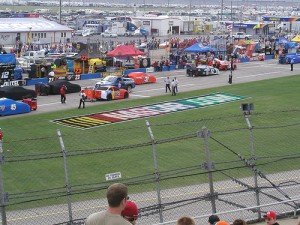
The fence at Talladega is supported by heavy cables. Click to see a larger view of the picture. (Photo by flickr.com user dhall / Creative Commons 2.0.)
After Jimmy Horton left the speedway in 1993, International Speedway Corp. lined all of their large tracks with cabled fences to keep cars from going over the wall. Along the front stretch grandstand area, this meant placing the cable fence in front of the previous chain-link debris fence.
Critics are claiming that Talladega is too dangerous of a place to race, and that NASCAR is irresponsible for racing there. And it is true that Talladega is dangerous... all motorsports are, and that is precisely part of the attraction. As Paul Page once said, "Without that risk, the men are just ordinary." Like it or not, we spectators participate in that risk and are drawn to it.
But there really is no reason to castrate a place like Talladega with limp-wristed solutions that permanently alter the very nature of the track. If safety is our only priority, why not just institute a 25 mph speed limit? Guaranteed no injuries... and no interest.
It Could Happen Anywhere
Because of the high speeds, it's easy to point the fingers at Talladega and Daytona as the tracks most likely to produce a disaster. But the cars go just as fast at Pocono, Indianapolis, Michigan, Atlanta, etc., albeit not for sustained speeds.
Some argue that cars are less likely to get airborne at the other tracks. And that's true... but it's still possible, and all you need is one incident. After all the incidents at Talladega in July 1993, I remember Benny Parsons saying that the only thing that could be done is leveling the banks and making a flatter track like that at Michigan, where the drivers have to let out of the gas through the turns. Only a couple weeks later when the tour moved to that very same track, Johnny Benson got turned sideways and his V6-car went airborne and flipped several times down the backstretch.
Even in the era of roof flaps it's possible: In 2000 Elliott Sadler blew a tire and went flying through turn 1, also at Michigan.
Many Ways to Get Airborne
At Talladega and Daytona we often see cars get airborne just from the "inverted wing" that occurs when they get backwards or sideways, but of course there are many ways to get a car into the air high enough to hit the catch fence. A quick turn to the right could easily roll a car over. (Watch Dave Blaney get turned and how in a split-second he flips over and heads into the wall.) Or, a car can launch over the front of another and get high in the air, like Geoff Bodine's did at Daytona in 2000.
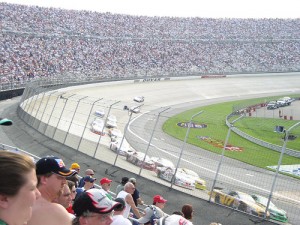
Does anybody seriously think this fence at Dover would hold up to a head-on impact from a 3500lb car traveling at 150mph? The fence didn't have an overhang until the late 1990s. (Photo by flickr.com user davidpb145 / Creative Commons 2.0.)
These types of crashes could happen anywhere. How well would other fences on the circuit hold up against direct, head-on impacts?
Don't Forget About Indy Cars
It's easy to pick on NASCAR, but I've long been concerned about an Indy car outright flying over one of these fences. The cars go so fast and are so light, and with the weight being in the rear of the cars it doesn't take much to get one to lift off from the front (by, for example, making wheel-to-wheel contact or even running over a piece of debris). Remember when Mario Andretti ran over some debris during practice at Indianapolis in 2003? His car went flying so high that it hit the very top of the fencing before coming back down. Imagine going into turn one at Indy and getting airborne that high just as the track angle turns.
Or consider Tony Renna's crash during tire testing at Indy in October 2003. Renna lost control exiting turn 3 -- one of the slowest parts of the track -- got backwards, went airborne and reportedly tore down 50 feet of fencing. Renna was fatally injured and although the tub of the car didn't make it through the fence, apparently a not insignificant portion of the car did. There is some controversy over exactly what happened, but nevertheless helicopter photos taken after the incident show that at least the railing of the concourse walkway was damaged. A concourse that could have been packed on race day.
The Best Solution
The best response to the Carl Edwards crash is to raise the fences at Talladega and Daytona by at least 5 feet, add a longer overhang, and add more cables to match the new height. Other race tracks should invest in the thicker cables as well. Perhaps a diagonal or hatched pattern for the cables would be more effective than the oft-employed horizontal style. (Though at some point you have to balance visibility with safety.)
The downside to the newer, stronger catch fences that have become more commonplace is that they absolutely shred Indy cars to pieces. (Watch Kenny Brack at Texas and Ryan Briscoe at Chicagoland.) But I lay that problem more on the cars than the fence.
Don't Forget About the Infield!
Some tracks that have infield spectators should probably ensure they're protected by a solid fence at well. Tracks like Pocono and Michigan... it wouldn't be difficult to get a car airborne and headed towards an inside fence.
Ohh yeah... it could happen at your local short track too!
At Least USAC Didn’t Try To Feign Competence
Posted by: | CommentsI feel bad now for poking fun at NASCAR's television ratings slide.
I just read over at Christopher Estrada's Indy Racing Revolution blog that the Versus network scored an amazing 0.15 rating for the Kansas 300 Indy Car race. The rating represents 171,000 households.
171,000? Holy crap there were probably more fans in attendance at Talladega than were watching that Indy Car race on TV. And the turnout for the Kansas race was abysmal at best (but let's blame that on weather).
Seriously though... why do they even bother racing this series anymore? It's plainly evident that there is no interest from the "higher ups" in making this anything more than a weekend hobby for rich jet-setters.
Speaking of insanity... here's another good article: IRL Thinking Big in China.
The Indy Racing League is taking a serious look at holding a race in China as early as 2011. Series officials said there are several good reasons why the league may want to head to the nation of 1.33 billion people.
“We’re looking at one existing and one new facility,” [IRL president of commercial division Terry] Angstadt told IBJ (Indianapolis Business Journal). “Chinese officials said they want a venue that will hold 500,000 people.”
lol... I don't even know what to say. They want to race at a venue that holds a half-million people and they can't even get over 170,000 people to watch a race for free on TV? I don't get it.
I'm in a mood to give useless advice tonight so here's a tidbit to offer: I don't think that flying teams to the other side of the world to run a race in front of 495,000 empty seats while being 12 time zones away from your core audience is going to do much to build fan interest here in America. I know that probably sounds astonishingly impossible, but I'd wager it's true.
Wait -- this explains it:
“A lot of our corporate partners and team sponsors have a serious interest in being in China,” Angstadt said. “Lots of IRL companies have business relations in China. For instance, Penske has operations in China and Menard’s buys in China. A race there would allow them to enhance those relationships and possibly forge new ones.”
Forget about Penske and Menard's -- what are you doing to attract fans to the sport?
Junior Gets It
Posted by: | CommentsThe toughest thing for me, as a race fan, in anticipation for a race at Talladega is the endless hype about the "Big One". Not that it isn't a legitimate story that needs to be covered, but the media people have taken it to a whole other level, and it's become so predictable. They seem to get as giddy as school girls talking about how awesome the racing is going to be because there will be the inevitable "Big One".
If the media folks like that kind of "racing", fine, but mark me down as a non-believer. Frankly, I think it's just plain embarrassing that they wad up a dozen or so cars on a routine basis at this race track. Half the field gets wiped out in a single incident that's usually caused by the slightest of bumps.
In all my years of frustration trying to express how much I hate the "Big One Mania" displayed by the TV networks, Dale Earnhardt, Jr. managed to nail my thoughts perfectly yesterday:
You have to understand that, like, for years, we have had wrecks like this every time we come to Talladega, ever since the plate got here -- and for years it was celebrated. The media celebrated it, the networks celebrated it, calling it 'the Big One,' just trying to attract attention and to bring people's attention to the race.
So there is a responsibility with the media and the networks and the sanctioning body itself to come to their senses a little bit and think about the situation. I mean, you can't sit here and jump up and down and go, 'Wow, what I saw today was crazy.' I don't think it's right ... but the media and the networks and everybody has been celebrating that stuff for years.
Who could disagree with him?
I got a chuckle watching SPEED's pre-race show where it was announced that Charlotte Motor Speedway (yeah I'm old school and still call it Charlotte) was having a "Big One" ticket sale promotion. A certain section of tickets would be sold at a price equal to the number of cars wrecked in the "Big One" at Talladega on Sunday. (And the way they were running there early on I thought the price of a seat would be $43.) It's pretty evident that many people in the sport aren't even taking it seriously anymore. What if a driver had been laid up in the hospital from the "Big One"? Their little promotion would look as tasteless as it really is, no?
And truly, if I read one more media article about how the fans love restrictor plate racing and "Big Ones" while they can't even sell the damn place out I'm going to throw up all over my keyboard.
Here's my take on it... I watched the SportsCenter highlights of the Talladega race Sunday night and it went like this: the first clip was the big lap 7 wreck that skimmed out a third of the field. The next clip was the big wreck on the backstretch within 10 to go. The last clip was Carl Edwards flying into the fence.
Now really... imagine you're not a race fan and you just witnessed those "highlights"... what are you going to think about the sport?
It's one thing to recognize that there's a problem with no decent solutions... but it's entirely different to, as Junior says, celebrate it.
Home Video of Edwards’ Crash
Posted by: | CommentsHere's some home video of Carl Edwards' crash from the front stretch grandstand at Talladega. Not sure who took the video but it was posted by NYJfan29rb on YouTube.
Umm... wow.
He was going fast.