Archive for Opinion
MY STORY
Posted by: | Comments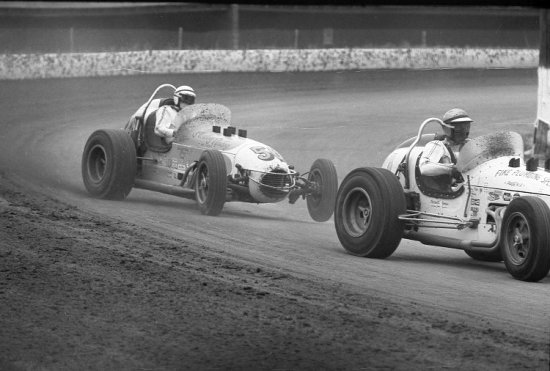
READING (PA) FAIRGROUNDS SEPTEMBER 14, 1963 USAC SPRINTS
Johnny White # 1 Fike Plumbing Special leads Jim Hurtubise in the # 56 Sterling Plumbing Special off of turn 4.
(WoS Photo)
It was around this time ... 56 years ago that I was a young kid working as a draftsman for a major heavy machinery manufacturer in Trenton, NJ. Like most guys of that age I was interested in cars. One day while eating lunch at my desk and reading Hot Rod Magazine, a summer intern engineering student came up to me and said that I should go see real racing on dirt. Well I was a stick and ball fan and watched just about every Yankees game on WPIX Channel 11 TV from NY. I didn’t know anything about racing except watching a few Jalopy (stock car) races from Culver City, California on TV. A few weeks later I was reading the sports section of the Trentonian newspaper and see an ad for USAC Sprint Cars at the Hatfield Speedway. I got out my gas station roadmap (no GPS back then) and found out where this Hatfield PA was and how to get there.
The day of the race came Friday July 26, 1963, after work I went home to change and with map and instructions in hand it was off to see what this was all about. When I found the track , an ambulance was coming out as I was parking my car. I later found out that Jim McElreath crashed into the first turn wall in practice. I got my ticket and saw all of the people in the stands and didn’t know where I should go. The track crew were trying to fix the wall and I saw other people going in the infield so that’s were I went. While walking around in the infield before racing resumed I ran into a guy who worked at the same place that I did He had been a new employee and I didn’t know his name. His name was Bruce Jones who would become a life long friend. He was with another guy named Jack Rule who just happened to be the brother of the engineer student intern at work who told me to go see real racing on dirt. The race drivers were named A.J. Foyt, Parnelli Jones, Bobby Marshman, Don Branson, Roger McCluskey, Bob Harkey, Jim Hurtubise, Earl Halaquist, Cotton Farmer, Jim Maguire, Arnie Knepper, Ron Lux, Chuck Hulse, Bud Tinglested, Chuck Yost, Ralph Liguori and others. When the green flag waved to resume practice all I could say to myself was WOW! What the hell have I been missing all of my life. I was hooked for the rest of my life. I became friends with Bruce & Jack. Bruce ran stock cars and I would hang out at the garage. We would go to watch a lot of races, sometimes 5 a week. We would see the best Modified stocks (dirt and asphalt), Midgets and Indy Cars, but nothing could compare with the Sprint Cars. There was just some magic watching them.
What was this force that had a grip on me, let me try to explain. When I first started to go to the races, open cockpit race cars didn’t have cages. When they would crash or go over it was like 50/50 if the driver would be badly hurt or be killed. It was an adrenaline rush watching them do something dangerously crazy. It’s the feeling you have if you were watching a man walking on a high wire 100 ft off the ground with no net and he is having a hard time keeping his balance. The adrenaline rush is because you see before you what can happen if he falls. That adrenaline rush would not be there if the walker was 20 feet off the ground and had a net under him.
It was all of this that branded my soul to love Sprint Cars, no stockcar could duplicate those feelings. Sprint Cars have become 1000% safer over the years, much so that some drivers don’t respect the car, only to be brought back to reality when we lose one of our drivers.
Today’s cars are basically the same cars that ran in the 1960’s. They have fuel injected engines, no transmission (must be pushed to start), quick change rear, 4-bar torsion, quick steering and no flywheel (the engine barks when you punch the gas).They have the newest gadgets but they still look the same on the track. If it’s a winged sprint you couldn’t tell if it was Kenny Weld or Donny Schatz; or wingless if it was A.J. Foyt or Brady Bacon. The cars still look the same way on the track as they did decades ago.
Fast forward to the other night at the Grandview Speedway, part of the 2019 PA Speedweek Series. Standing between the first and second turns taking pictures and watching the 900 plus Horsepower Sprints taking time. They run wide open all the way around, no change in the sound of the motor. If you closed your eyes you couldn’t tell the turns from the straights. After 56 years there is still magic watching the fastest race cars on dirt.
Since Racing Season is Upon Us……
Posted by: | CommentsRacing season has started in this part of the country. It is not yet in full swing but it will be in just a few short weeks. I’d like to post up a little public service announcement for all the drivers out there for the upcoming season.
Be good to your fans. It is important for many reasons.
As a driver, I never had fans. I never had anyone who came up to me after the races. In a way, that was a good thing. I don’t know if I would be able to follow the advice I am about to give to you along with some examples. What I do have experience with is being a fan who has been treated very well by some of my heros and very poorly by others. Many years later as a car owner I’ve also been there when many of my drivers did the right thing.
Let’s start with the good. My Dad, his friends, and I went to the Bristol, Tennessee NASCAR race back in the mid 1990’s. One late afternoon we were driving around the town of Bristol (bustling metropolis....) and ended up cutting through the back of a hotel parking lot. Who was there? NASCAR legends Harry Gant and Bobby Allison. They walked right up to Big Red (our truck) and struck up a conversation like we were old friends. These guys were most likely going back to the hotel after a long day at the track but took the time to bullsheet with a bunch of yahoos from New Jersey and sign some stuff for us. They could have waved and walked by but they did not. They were really nice guys. They made us like them even more just by taking a few minutes out of their day.
Then, onto the bad. As a kid growing up I was a fan of one of the local dirt track guys who, believe it or not, is still running to this day. I wrote him a letter when I was about 10 years old that included a picture I drew in art class of his car. My Mom and I included a stamped envelope for him to send it back. In my 10 year old handwriting, I told him how much of a fan I was and I politely asked him to sign the picture and send it back.
It never came. Weeks went by.
In a rare move we stuck around Bridgeport Speedway one night until the races were over to go into the pits to see if he got it. My Dad and I usually didn’t do this as we had an hour ride home. When I finally got to meet him, I clammed up. It may be hard to believe but I was actually a pretty shy kid. So, my Dad piped up and asked him if he had gotten the picture. His response?
“Yea”
That was it. No...hey that was nice, hey I forgot to send it back, nothing. Just a passing “yea” and then onto another conversation with someone else.
As a ten year old, I was crushed. I remember my Dad being pretty pissed off but didn’t make a scene of any kind.
Now...while you may be psychoanalyzing me wondering why I have held onto this memory for 30 years, relax. I don’t think about this every day. My future was not crushed because of that moment. I didn’t even cry back then and certainly don’t cry about it today.
Here’s the point: I went to the track damn near every Saturday night in 1985 to see how this driver would do. I bought his T-shirts (up until then) and his hats. And 25 years later I even considered putting this guy in my own racecar when the seat became available...but I didn’t.
That 10 year old kid might grow up to own a business when you are still behind the wheel and be willing to sponsor you. That 10 year old kid might own a racecar someday and be out of a driver looking for someone to fill the seat. That 10 year old kid might someday be your competition and rub you up the track the wrong way. That 10 year old kid’s Dad might be willing to sponsor you. All selfish reasons aside....it boils down to just being a good person. We are a very small circle of people and paths cross every day.
As a racecar driver you are a public figure. You need to treat everyone the best you can even after you’ve had a bad night. I know some nights it is tough...believe me. But I have been witness to some great acts by those who have driven cars for me. Every one of them was great with the fans. Here are some examples:
Jeff Geiges: Jeff was always great with the fans. He’s managed to become a fan favorite due to his crazy laugh and general great attitude towards life. Jeff had a special needs adult become a super fan of his in 2010, the year we won the TSRS championship. This woman was in the pits just about every night at New Egypt after the races were done. She was an adult who had a difficult time communicating. She would come down and patiently wait behind the car while the rowdy crew, aka “Those Guys” were most likely 3-4 beers deep by this point laughing and carrying on. Jeff always went out and talked to her for a few minutes. What they talked about...no idea. We left them alone. But the point was....he could have ignored her. He didn’t. It was the right thing to do.
Stef Palmai: Stef starting driving my car as a high school student. She had two major fan draws for her...she was young and a female. Therefore, all the kids loved coming up to her. She was always prepared to deal with them. She got down low and met them eye to eye to talk to them like they were equals. Stef also had to deal with some creepy dudes. There were a few guys who...well...acted very strange around her. She treated them with respect but managed to cut off the conversation when it needed to be. Even in the face of some creepers she never blew them off like she would have been justified in doing. She was mature beyond her years in dealing with the fans. She did the right thing every time.
Billy Pauch Jr: Billy is a big draw for many reasons. He is great with the fans, even when they get numerous. Because of this (and his on track performance) he has a great business in T-shirts and apparel that helps fund his racing operation. This is a benefit of being well spoken, respected, and an all around good guy. Billy also has to deal with the fans that want to talk about his Dad, who is one of the best ever. Why in the world anyone would approach Jr. at the end of the night after he just won and want to talk about his Dad winning the Shammy Shine 100 at Flemington in 1988 is beyond me (I’ve seen it...it happened). There were many times I wanted to reach across and grab these people by the throat. I mean..if you want to talk about Billy Sr...go talk to Billy Sr...he’s 4 trailers down. BUT....Billy does not blow them off. He politely chats for a minute or so and moves on.
So, as the season starts, remember this: You never know who that fan is. They might help you in the future. They might buy your T-shirts. They might defend your family in the stands when you take someone out on the track. They might sponsor you. Or, they just may be a nice person looking to talk to their hero.
The fan base of circle track racing is shrinking.
It costs nothing to be a decent human being to help who is left stay around.
TODAY’S RACING NEWS LINKS
Posted by: | CommentsWalmart Brings Affordability, Accessibility to Michigan NASCAR Fans
Big-name NASCAR drivers need to pick up speed in Sprint Cup Series
Going green in NASCAR means fewer cautions, crashes
Debate:2012 Richmond: Toyota NASCAR Sprint Cup Race Tidbits
Debate:Should NASCAR juice races by throwing more cautions?
Can Nascar Help Sell Ford’s Electric Focus?
What's Up With Kyle Busch In 2012?
Will Richmond end the latest caution debate in NASCAR?
IndyCar: Andretti Autosport's James Hinchcliffe Is Ready to Take the Next Step
Team Penske seeks to continue IndyCar dominance in Brazil
JR Motorsports (Cole Whitt / Danica Patrick) Richmond International Raceway Preview
INDYCAR: Team Chevy Racing ready for debut on the streets of Sao Paulo
The chase is on for teen driver Elliott
'The best short track we have'
Travis Pastrana ready to make his NASCAR Nationwide Series debut at Richmond
CUP: Goodyear Tire Test At Pocono Q&A
CUP: Winning Becoming More Critical
Dodge City Raceway Park Set for USAC Midget Double
In NASCAR, cautions are bad, except when they are good
Who Will Win the Richmond 400 in NASCAR Sprint Cup? Here’s a Fan’s Top Seven
NASCAR drivers give double thumbs up to Pocono Raceway resurfacing
BIG CROWDS FILL THE AISLES DURING THREE DAY MOTORSPORTS 2012 SHOW
Posted by: | Comments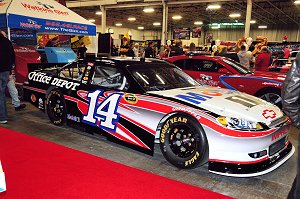 Tony Stewart's # 14 Sprint Cup car at Motorsports 2012
NEWS FROM:
MOTORSPORTS 2012 PRESENTED BY VP’S SEF SMALL ENGINE FUELS
RACE CAR AND TRADE SHOW
Promoter: Len Sammons @ 609.888.3618
MEDIA CONTACT: Ernie Saxton Communications, Inc.
Ernie Saxton @ 215.752.7797
Fax: 215.752.1518
Cell: 267.934.7286
Email: Esaxton144@aol.com
FOR IMMEDIATE RELEASE PLEASE WITH OUR THANKS
-----------------------------------------------------------------------------------------------------
BIG CROWDS MAKE MOTORSPORTS 2012 A SUCCESS STORY FOR 27TH YEAR
OAKS, PA January 23, 2011 . . . Large crowds jammed the aisles and exhibitors did brisk business at the Motorsports 2012 Presented by SEF Small Engine Fuels Race Car and Trade Show. Racers, fans and promoters filled the three day show at the Greater Philadelphia Expo Center to see just about everything imaginable in motorsports. Attendance was up considerably over past years for Friday and on the closing day, Sunday. A big crowd filled the Expo on Saturday despite the first winter storm to hit the area this season.
NASCAR Sprint Cup star Matt Kenseth, four time NASCAR Camping World Truck Series champion Ron Hornaday, drag racing legend Bill “Grumpy” Jenkins, five time NASCAR Sprint Cup champion crew chief Chad Knaus, former NASCAR star now SPEED TV personality Jimmy Spencer and a host of other well known figures in the sport were on hand to visit with fans and sign autographs.
“Our sales were good this year and every year. We know the market, the people know we are going to be here and give them good prices,” said Jeff Behrent of Behrent’s Performance Warehouse (Florida, NY).
Other vendors, filling more than 600 exhibit areas, shared the same enthusiasm about the show with several already making plans to return with the show takes place again in January, 2013.
No less than 250 race vehicles representing a wide variety of motorsports were won display and enjoyed by the fans.
Attendees also had the opportunity to visit various speedway displays collecting information on the 2012 season that will help them make plans for the events they want to attend.
“We do this show to meet the racing public, get exposure, and give something back to the sport, “ said VP Racing Fuels’ Fred Turza. “The Motorsports show has been excellent for what we are trying to achieve.”
One of the many highlights of the show was the annual BPG Racing Ms Motorsports Pageant won this year by Ms. Samantha Legas. The 20-year-old resident of Savannah, NY picked up $1,500 as the new Ms. Motorsports and will now represent the show through a number of personal appearances at motorsports events throughout 2012.
“I never expected to win Ms. Motorsports since I never had entered a pageant before,” said Legas. “I enjoy modeling, I enjoy racing and this is an opportunity to do both. I’m really looking forward to it.”
First Runner-up was 21-year-old Kasey Missimer of Bechtelsville, PA representing NASCAR sanctioned Grandview Speedway. Kasey also has the opportunity to be Miss AARN. Should Legas not be able to fulfill her obligations as Ms. Motorsports Kasey would step in.
Second Runner-up honors went to Mindy English of Addison, NY. The Dangerous Wines Swimsuit Winner was Kimmie Trout of Reading, PA.
The MetalFab sponsored Sunday activities included the Little Miss Motorsports Pageant with eight year old Carlee Strunk, daughter of 358 Modified racer Glenn Strunk, of Bechtelsville, PA earning the title. First Runner-up was Brianna Carter of New Egypt, NJ with Second Runner-up honors going to Kylie Murray of Pottstown, PA.
In the Tiny Miss Motorsports Pageant seven year old Samantha Idele of Southampton, NJ walked off with the top prize while First Runner-up honors went to Raclyn Eisenhard who calls Reading, PA home. Second Runner-up was Samantha Grice of Newark, Delaware.
Also on Sunday Joshua Fisher lead Jacob Reinfendifer and Cody West across the finish line in the 7-9 bracket of the Big Wheel racing action. Shane Rothman was tops in the 5-6 year old class with Bryce Smith and Gunnar Zeiner (son of late model racer Zane Zeiner) following. Mia Hirschman, granddaughter of asphalt modified racer Tony Hirschman Sr., won the 3-4 year old feature with Mackenzie Adams and Lainden Hinds finishing second and third.
Best Booth Awards were earned by:
Best In Show: Four Star Lettering
Best Commercial Booth: DMI
Best Quarter Midget Booth: Doylestown Quarter Midgets (Honeybrook)
Best Vintage Club: Garden State Vintage Stock Car Club
Best Speedway Booth: NASCAR sanctioned Grandview Speedway
Best Car Award went to:
Best Stock Car: Matt Jester (BD Media Booth)
Best Open Cockpit Car: Nick Schlauch, Sr. (Lincoln Speedway Booth)
Best Drag Car: Mike Clayboss 1970 Buick (VP Booth)
Best Vintage Stock Car: Frankie Schneider Sedan (Nazareth Reunion)
Best Vintage Open Cockpit Car: “White Phantom” (Flemington Historical)
Plans for the 2013 edition the Motorsports show will be announced shortly. Companies wishing to get on the mailing list to receive 2013 exhibitor information, which will be available in less than a month, can do so by writing to motorsports@aarn.com. Fans can also join the mailing list by writing to the same address.
“We would love to hear from show attendees/fans/racers with their opinions about the show,” said show producer Len Sammons. “We are always looking for suggestions regarding the show. We think we had a great show this time around but we always feel there is room for improvement.”
MEDIA NOTE: Our thanks to all of you for making this another successful event. Ernie Saxton on behalf of Len Sammons Productions.
ERNIE SAXTON COMMUNICATIONS, INC.
Motorsports Marketing - Sponsorship Consultant
Columnist- Broadcaster
215.752.7797 - PA. Office
386-677-5152 - Florida until March 16
267.934.7286 - cell/text
Esaxton144@aol.com
www.saxtonsponsormarket.com
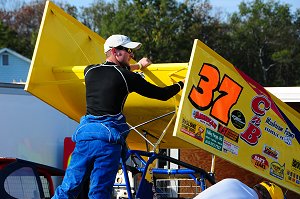 JJ Grasso
FOR IMMEDIATE RELEASE---THANK YOU
CONTACT: BOB MILLER 443 513 4456
THE JERSEY RUSH AT NEW EGYPT
410 Sprints & Modified Double-header. . . . . .
JJ GRASSO TO MAKE 410 SPRINT DEBUT AT NEW EGYPT ON TUESDAY NIGHT, AUGUST 30 IN THE "JERSEY RUSH"
JJ Grasso, know in the 360 sprint ranks as the "Jersey Jet", will make his 410 sprint debut in the "JERSEY RUSH" 410 sprints and modified double-header at the New Egypt Speedway on Tuesday night, August 30.
Grasso is known for his flat out driving style and he always shows his best at the New Egypt Speedway, a track that he has dominated for several years. Grasso, will strap into the 410 sprint car owned by John Pinter and sponsored by The Audi Shop. CnB Mushrooms Chubby Ciarrocchi was instrumental in pulling together all the players to make this Pinter/Grasso merger happen. Pinter, a successful former modified driver himself, will also field his primary 410 sprint car that is driven weekly by Central Pennsylvania "hot shoe" Kevin Nouse.
Grasso was the 2009 URC Champion and is URC's current point leader with three wins this season and nineteen career URC triumphs. It's a great opportunity for Grasso to compete at his favorite track and there is no doubt that he'll be racing against some of the best drivers in the business of 410 sprint car racing. As for this big opportunity, Grasso is excited, Pinter is confident and Chubby just can't wait for August 30 and the "JERSEY RUSH".
Competition will be keen with nationally known drivers like Fast Freddie Rahmer of Salfordsville, PA, Tyler Walker of Los Angeles, CA a former 410 sprint car feature winner at New Egypt, Justin Henderson of Sioux Falls, SD, Greg Hodnett of Memphis, TN, Daryn Pittman of Owasso, OK, Lance Dewease of Fayetteville, PA, Davey Sammons of Bordentown, NJ, Mark Smith, Chad Layton, Frank Cozze, Kevin Nouse, Dave Ely and URC's seven time champion Curt Michael are just a few of the early pre-entries.
The 410 sprints are without a doubt the fastest race cars on dirt, with 900 horsepower and a weight of just 1,400 pounds, these cars will fly around the always exciting 7/16 mile "D" shaped speedway at speeds topping 120mph. Just imagine, twenty-four 410 sprint cars starting two abreast and taking the green flag as they race into that first turn! You'll first hear the roar, then feel the rumble when this race begins.
The sprints will compete in time trials, heat race events and a "B" Main (consolation) all leading up to the JERSEY RUSH, a 30 lap feature paying $5,000 to the winner.
There is still more to this show.
Also on the program will be the Big Block Modifieds, the traditional weekly star-filled division at New Egypt Speedway. Billy Pauch, Rick Laubach, Willie Osmun, Jimmy Horton, David VanHorn, Richie Pratt, Wade Hendrickson and a host of other modified stars will be on hand to chase the $3,000 first place prize to win the 30 lap modified feature. Heats and a consolation will determine the twenty-four car starting field. Between the 410 Sprints and Big Block Modifieds, one can expect "Double Trouble" in the twin 30 lap feature events.
A Driver & Crew Meet and Greet is being planned by race organizers for fans to get an up close look at the drivers and cars. The Meet & Greet will take place from 5-6 PM. The gate from Victory Lane (behind the turn four seating) to the pit area will open to allow spectators to go pit side for one hour prior to the start of this blockbuster event. Come out early and enjoy a great night of racing.
General admission is $30 for adults, $10 for children 6-11 and kids under the age of six will be admitted for Free. The pit fee is $35 and a license is not required.
The event is a co-promotion between Lenny Sammons, his sons and special events organizer Bob Miller.
New Egypt Speedway Track Facts:
Event: THE JERSEY RUSH 410 Sprints & Big Block Modifieds
Race Date: Tuesday, August 30 7:30 PM Gates Open at 5 PM
Rain Date: Wednesday, August 31 7:30 PM
Location: New Egypt Speedway 720 Pinehurst Road New Egypt, NJ 08533 (On Route 539)
Track Phone: 609-758-1900
Website: www.newegyptspeedway.net
Admission: Adults $30, Children 6-11 $10 Pit Fee $35
For Additional information: Call Bob Miller 443 513 4456
Past 410 Sprint Winners at New Egypt:
2007 Steve Kinser
2003 Donny Schatz
2002 PJ Chesson
2001 Donny Schatz
2000 Tyler Walker
1999 Billy Pauch
__________________________________________________________________
*Amenities: The entire New Egypt Speedway facility features a daylight-quality lighting system and excellent sightlines from any seat in the house. The track is fully wheelchair-accessible with wide, clear, and well-groomed walkways. There are clean, heated restrooms, and a monitored playground area for the littlest fans. Whistle-clean concession facilities serve up everything from sausage sandwiches to ice cream treats at family-style prices. Our dynamic-duo of track announcers keep fans informed and involved with a state-of-the-art sound system.
*The Track: The racy, 7/16-mile D-shaped clay oval, plays host to some of the tightest, all-out wheel-to-wheel competition you'll ever witness.
GAS CITY USAC MOPAR MIDGET INDIANA MIDGET WEEK RESULTS
Posted by: | CommentsUSAC MOPAR NATIONAL MIDGET CHAMPIONSHIP RACE RESULTS: June 8, 2011 – Gas City, Indiana – Gas City I-69 Speedway – “Indiana Midget Week”
QUALIFICATIONS: 1. Bryan Clauson, 39, Tucker/BCI/Curb-Agajanian-12.737; 2. Hunter Schuerenberg, 35, Rock Steady-12.796; 3. Bobby East, 4, Klatt-12.865; 4. Tracy Hines, 24, Parker-12.865; 5. Zach Daum, 5, Daum-12.867; 6. Darren Hagen, 3, RFMS-12.882; 7. Shane Cottle, 1st, Saucier-12.963; 8. Chris Windom, 11, Wilke-Pak-12.989; 9. Levi Jones, 20, Stewart-13.006; 10. Caleb Armstrong, 71, Kunz-13.020; 11. Jerry Coons Jr., 3nz, JCJ-13.042; 12. Kyle Larson, 67, Kunz-13.059; 13. Billy Pauch Jr., 54, Burke-13.111; 14. Jimmy Simpson, 21, Simpson-13.133; 15. Thomas Meseraull, 16, Sandy-13.134; 16. Trevor Kobylarz, 49, Two Dogs Racing-13.137; 17. Brad Kuhn, 17B, RW-13.193; 18. Levi Roberts, 2D, Roberts-13.214; 19. Michael Pickens, 29, Berry-13.230; 20. Alex Bright, 77B, Hemler-13.252; 21. Kellen Conover, 76, Conover-13.253; 22. Chase Barber, 91, Barber-13.255; 23. Davey Ray, 2R, Ray-13.258; 24. Nick Wean, 78, Wean-13.271; 25. Matt Westfall, 14w, Bordner-13.274; 26. Steve Buckwalter, 25,
Buckwalter-13.274; 27. Tanner Swanson, 19, Team 6R/TK-13.280; 28. Jimmy Glenn, 07, Glenn-13.404; 29. Ryan Smith, 33, Steward-13.416; 30. Mario Clouser, 06, MCM-13.423; 31. Matt Smith, 13, Smith-13.450; 32. Michael Koontz, 17k, Koontz-13.577; 33. Justin Grosz, 99, Grosz-13.655; 34. Jacob Wilson, 10, Moore-13.714; 35. Dalton Armstrong, 71k, Kunz-13.876; 36. Danny Stratton, 77, Hampton-NT; 37. Dillon Welch, 51, DMS-NT.
FIRST HEAT: (8 laps) 1. Kuhn, 2. Clauson, 3. Daum, 4. Jones, 5. Pauch, 6. R.Smith, 7. Westfall, 8. Grosz, 9. Conover. NT
SECOND HEAT: (8 laps) 1. Schuerenberg, 2. Hagen, 3. C.Armstrong, 4. Clouser, 5. Barber, 6. Simpson, 7. Roberts, 8. Wilson, 9. Buckwalter. 1:43.14
THIRD HEAT: (8 laps) 1. Pickens, 2. D.Ray, 3. Coons, 4. East, 5. Cottle, 6. T.Swanson, 7. Meseraull, 8. D.Armstrong, 9. M.Smith. 1:43.61
FOURTH HEAT: (8 laps) 1. Bright, 2. Windom, 3. Hines, 4. Larson, 5. Kobylarz, 6. Wean, 7. Glenn, 8. Koontz, 9. Welch. 1:43.19
SEMI: (12 laps) 1. Cottle, 2. Meseraull, 3. Pauch, 4. Kobylarz, 5. T.Swanson, 6. R.Smith, 7. M.Smith, 8. Stratton, 9. Buckwalter, 10. Roberts, 11. D.Armstrong, 12. Welch, 13. Koontz, 14. Westfall, 15. Wean, 16. Barber, 17. Simpson, 18. Wilson, 19. Glenn, 20. Grosz. NT
FEATURE: (30 laps) 1. Darren Hagen, 2. Zach Daum, 3. Tracy Hines, 4. Bobby East, 5. Hunter Schuerenberg, 6. Bryan Clauson, 7. Kyle Larson, 8. Chris Windom, 9. Shane Cottle, 10. Levi Jones, 11. Thomas Meseraull, 12. Brad Kuhn, 13. Caleb Armstrong, 14. Ryan Smith, 15. Trevor Kobylarz, 16. Tanner Swanson, 17. Alex Bright, 18. Davey Ray, 19. Mario Clouser, 20. Dalton Armstrong, 21. Jerry Coons Jr., 22. Michael Pickens, 23. Billy Pauch Jr., 24. Levi Roberts. NT
---------------------------------------------------
**Glenn flipped at the start of the semi.
FEATURE LAP LEADERS: Laps 1-12 Daum, Laps 13-30 Hagen.
NEW USAC MOPAR NATIONAL MIDGET SERIES POINTS: 1-Hagen-303; 2-East-292; 3-Clauson-267; 4-Daum-239; 5-Hines-236; 6-Larson-205; 7-Kuhn-183; 8-Coons-180; 9-Roberts-176; 10-C.Armstrong-164.
NEXT USAC MOPAR NATIONAL MIDGET RACE: June 9 – Putnamville, IN – Lincoln Park Speedway – “Indiana Midget Week”
Should IndyCar Have a Fuel Rule?
Posted by: | CommentsIn the wake of Mike Conway's scary crash on the final lap of the Indy 500, Arie Luyendyk is questioning whether the IndyCar Series should require competitors to meet a minimum fuel level through the end of the race. Luyendyk, himself a two-time winner of the 500, believes it's too dangerous for drivers to implement fuel-saving strategies on ovals.
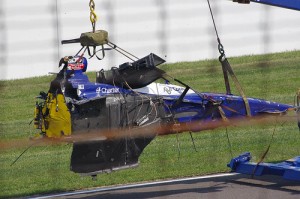
The remains of Mike Conway's car after getting into the fence at Indianapolis. (Mr. 0 photo, flickr.com / CC 2.0)
Conway's car got airborne after clipping the left side of Ryan Hunter-Reay, who suddenly slowed after running out of fuel in turn three on the final lap of the race.
Would this be a good rule to have on the books, or is this just a knee-jerk reaction to an ugly crash?
Imagine for a moment that there was a rule requiring finishers to have at least 1.5 gallons of fuel in the tank after finishing the race, which is apparently similar to what Formula One requires. What if a driver just won the Indy 500 and in post-race inspection the officials were only able to siphon out 1.45 gallons of fuel? What would they say? "Sorry boys... we have to take that trophy away!" Or perhaps the team would just be fined -- which amounts to no deterrence at all. In practice I believe it would be a very unpopular rule.
While I hate that the crash happened and that Conway was injured, we have to admit that it's just something that happens in this sport. Ordinarily the circumstances involved are not a problem: if drivers are too slow they are black-flagged or at least relegated to running on the track apron. Indy is a bit more complicated since the speeds are so fast and there is essentially only one racing lane. Making matters worse, they removed the track apron in 1993 (preferring warmup lanes), taking away a large portion of track that could be used by drivers to avoid an incident or to pull down and out of the way if a problem occurred with the car. Maybe a better question to ask is whether or not Indy cars really need to go a zillion mph in the first place. Does it really put on a better show?
Let's be thankful we got through another oval race without a large portion of a car flying up into the grandstands and keep it at that.
And that reminds me...
What was with all the black-flagging for "blocking" during the Indy 500? Didn't it get a bit excessive? I saw instances where a car was down low and a driver attempted a pass where it was nowhere near humanly possible and still the leading car got a black flag for what amounted to moving over a couple of inches. What happened to finding a way to set the guy ahead of you up for a pass? Or maybe trying to pass on the outside of a straightaway?
If I were a new fan watching that race I would have concluded that if a driver wanted to pass on the inside, it was the lead driver's obligation to move over and let him pass. And we're to believe that the future of Indy car racing is in better hands now that Tony George is gone?